This is the first book I have read in a while that I went through from cover to cover. It provided a really good lens on how we can make sense of things around us.
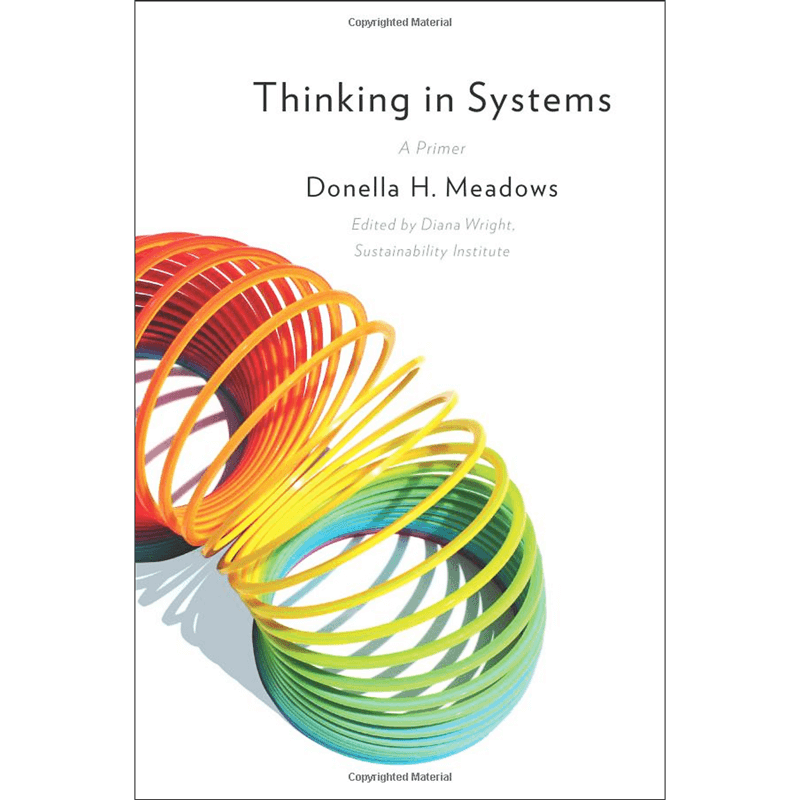
Thinking in Systems by Donella Meadows convinces us to see the world as interconnected through mechanisms of loops and feedback. Nothing is isolated. The system produces outcomes that nobody necessarily planned or intended: the structure itself, the loops and connections; generates the behavior we see. This is not a coordinating force imposed from outside, but rather the arrangement of parts producing results on their own. Meadows is essentially offering us a new lens in seeing things: that the world was always interconnected. She is just giving us a way to see and map it.
Now this is where it gets exciting. Systems can exist within a bigger system, each having its own elements (stock, actors) and relationships or interconnections. Now I focus on the stock. This concept can be anything of value. In economics, we see this as accumulated land, labor (a population’s skill level), and capital.
The book explains this using bathtub logic. The stock is the water in the tub. The goal is to keep water levels constant. This is a balancing loop, one that resists change and seeks equilibrium. It works through a faucet that fills the tub and a drain that opens when water rises too high and closes when it falls too low. But there is a second type of loop: the reinforcing loop, where change feeds on itself and keeps growing in one direction. Think of a savings account earning interest: the more you have, the more you earn. Together, these two loop types explain most of the behavior we observe in systems.
Now actors can be institutions or people of varying groups, acting within the system and pursuing their personal interests while working within what the system allows in order for it to continue functioning. This makes feedback loops more critical, as these actors can act on pure self-interest as long as the system permits it. However, it is worth noting that resilience in a system does not mean tolerance of self-interest. It just means it can absorb disturbances and recover without losing its core function. Self-interest becomes a problem specifically when it erodes the feedback loops that keep the system in balance.
As I read this, the first thought that came to mind was, "Wow, we have failed as a society!" Applying this to how we see growth in the economy, I see the system geared towards capitalism instead of focusing on stocks that hold real value. We put so much weight on progress measured by economic growth or gross domestic product (GDP). But GDP as the dominant measure of success is pointless as a goal in itself. Economies would grow regardless because population expands and innovation continuously improves productivity and efficiency. The real question is what is actually accumulating or depleting beneath that number. Chasing the measure while neglecting those underlying stocks is, I believe, where the design breaks down.
Monitoring natural resources, or any important resource, as stock can be a better measure of a system's true health. Are we using them efficiently, or depleting them faster than they accumulates? Treating resources as stocks creates natural checks and balances on how actors within the system use them. Do actors waste them or use them efficiently? What mechanisms exist to ensure these resources are distributed equitably? How accessible are they for all?
Now consider the role of institutions. Through policies, institutions can direct behavior and limit the self-interest of actors by anchoring everyone toward a common goal. This is the weakest link in most economies I have observed. Institutions often do not understand what actors truly need and therefore cannot craft laws and policies that push nations toward a richer existence, not in an economic growth sense, but in terms of how efficiently they build and sustain the stocks that actually matter. So instead of treating GDP, unemployment, and trade as the goal, we should use them as feedback signals—indicators of how the system is flowing—while recognizing real stocks like natural resources, minerals, and quality of life as the true measure of wealth.
Standard of living alone is a powerful indicator. It captures inequality within a system and across systems in a way that GDP cannot, and it brings us closer to what growth should actually mean. It is a kind of growth that allows wealth to trickle down and reach the poorest of the poor and give everyone an equitable share.
For nation builders, this is something worth thinking about.
If my words from Oh! The Places Within resonate, stir something, or simply keep you company, you can support my work with a cup of coffee (or tea 🍵). Every little bit helps me keep writing, reflecting, and showing up with honesty and heart, here at: https://ko-fi.com/placeswithin. Or scan below: